I just finished reading the book Security and Usability a compilation of many papers about this topic. And like all books that are like this there are always good parts and bad parts, this also applies to this one. There are some really good chapters that teach you new stuff and some chapters that are quite boring. Because they are scientific papers some chapters are hard to read and I would by now means describe it as a casual easy to read book that you can just enjoy like Bruces Beyond Fear. But it still touches a lot of interesting topics that I think a well educated person in IT should know about, like graphical passwords and biometrics. Another really good point is that it is not only written by scientist but also by people from industry that describe how they solved problems in the real world. I was pleasantly surprised that also some Open Source projects where described. Because of this it is not a classical collection of "boring" papers. Unfortunately the book is five years old and so some topics have already been solved or not really applicable anymore, so maybe some selective reading is at hand. I also found some errors in the book and tried to get them fixed but I got no reply from the authors, so I am assuming that there is no interest in this book anymore. Despite this, it is still a really good book and really good read, and you can just have it lying around and read a chapter once in a while.
Showing posts with label books. Show all posts
Security and Usability book review
I just finished reading the book Security and Usability a compilation of many papers about this topic. And like all books that are like this there are always good parts and bad parts, this also applies to this one. There are some really good chapters that teach you new stuff and some chapters that are quite boring. Because they are scientific papers some chapters are hard to read and I would by now means describe it as a casual easy to read book that you can just enjoy like Bruces Beyond Fear. But it still touches a lot of interesting topics that I think a well educated person in IT should know about, like graphical passwords and biometrics. Another really good point is that it is not only written by scientist but also by people from industry that describe how they solved problems in the real world. I was pleasantly surprised that also some Open Source projects where described. Because of this it is not a classical collection of "boring" papers. Unfortunately the book is five years old and so some topics have already been solved or not really applicable anymore, so maybe some selective reading is at hand. I also found some errors in the book and tried to get them fixed but I got no reply from the authors, so I am assuming that there is no interest in this book anymore. Despite this, it is still a really good book and really good read, and you can just have it lying around and read a chapter once in a while.
Peer to Peer Computing: The Evolution of a Disruptive Technology
Another book I just read is
Peer to Peer Computing: The Evolution of a Disruptive TechnologyThis is a collection of papers that have P2P as a central topic. With all these collection books some of the articles are really good and some of them are really bad. I was a little disappointed that the coherence was not as good as you would expect. There where quite big logical gaps between the different articles. But overall I learnt something but not too much. It was a good read because I didn't really know much about it, except having used P2P, but I was never really aware of all the research that has gone into it. It really astonished me that people did all this work on something that I always perceived as something for people to steal music. Because of the article base there is also some repetition but this is hard to avoid. The biggest problem I have is the price with £62.65 for something I could have found out by using Goog$e scholar it is a little steep and not worth the investment. If you want to learn something about this technology use a search engine and print it. The paper for the text will cost you 3 Pounds and you have saved 60. ConclusionL: An academic text trying to describe what hackers have come up with.
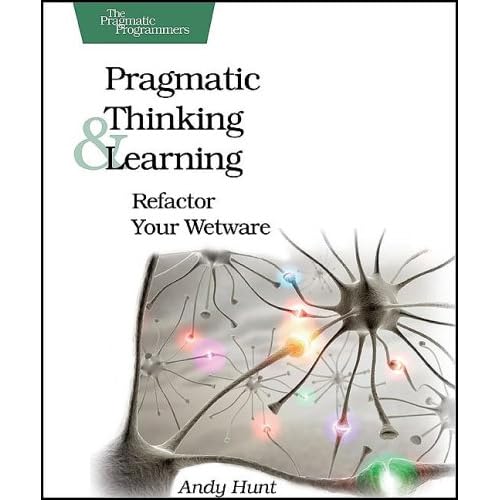
Pragmatic Thinking and Learning: Refactor Your Wetware
I have been reading quite a lot of books lately. (One every two days on average) So I want to start blogging about them a little more and share my thoughts. One book I bought because I liked the title was
Pragmatic Thinking and Learning: Refactor Your WetwareI have always been interested in how my brain works and have already read quite a lot about this topic, so I didn't really expect too much from this. The Pragmatic Programmers series is really good at introducing you to a subject but normally if you have a little knowledge about the area it will not introduce anything new. Looking back I had the same experience with the The Pragmatic Programmer which doesn't mean that it is a bad book, actually I really enjoyed reading it. Ok so after going over that your brain has two sides and that they behave differently the book goes into a little more detail and explains what you can do to use this power. I really liked that there where all these examples and stuff to do while you where reading it. I had to draw a man sitting the wrong way up and this made it really fun to read. Further this book is really worth reading if you are a geek or use computers a lot. It is full with little programming references and jokes. Sometimes "brain" books can be really dull and full of theory, this book took a different approach and normally after some easy to understand explanation it explained how you can use this function of your brain to your advantage and how you can utilize it more effectively. They seam to quote their other books a little too much for my opinion but it was still a really good read and if you don't know anything about this area you should definitely read it.
How to convert CHM file to PDF under CentOS
I have an ebook readerso I have been looking at a loot of ebooks lately. There are many free books out there I would have never taught about reading ever again, Sherlock Holmes being one of them. But one problem I am facing is that some books are in the CHM format, I have no idea who came up with this but now it seams sort of outdated and not used for this purpose any more. PDF has won the game. So how do I convert these CHM files to PDF so I can read them on my reader.
Step 1:
Use the program kchmviewer ($ yum install kchmviewer ) to extract the HTML from the CHM. CHM is just a nice wrapper for html with some images, so this is a fairly straight forward task.
Open the file with kchmviewer
Extract it by using the tool found under File -> Extract
Now you should have many HTML files and some images. This might already be enough for you reader but I prefer to have everything in one file and not have 100 of html files clogging everything. So the next task is to convert all these files into one coherent pdf file.
Step 2:
Use these htmldoc ($ yum install htmldoc) to generate a PDF.
Now the only thing you have to do is import all the html files and configure the output you want and you should get a pdf. This might not look 100% like the book but the text and images should be the same.
It is also possible to remove some chapters and modify some stuff. So if you know you are not going to read something you can just leave it out.
Step 1:
Use the program kchmviewer ($ yum install kchmviewer ) to extract the HTML from the CHM. CHM is just a nice wrapper for html with some images, so this is a fairly straight forward task.
Open the file with kchmviewer
Extract it by using the tool found under File -> Extract
Now you should have many HTML files and some images. This might already be enough for you reader but I prefer to have everything in one file and not have 100 of html files clogging everything. So the next task is to convert all these files into one coherent pdf file.Step 2:
Use these htmldoc ($ yum install htmldoc) to generate a PDF.
Now the only thing you have to do is import all the html files and configure the output you want and you should get a pdf. This might not look 100% like the book but the text and images should be the same.It is also possible to remove some chapters and modify some stuff. So if you know you are not going to read something you can just leave it out.
How to Simplify Your Life
If you are, just a little, successful in life do not think about buying or even reading this book. Because you will know everything already. But as I already mentioned if you want to kill yourself and you want good to help you get on the right path, please PLEASE read it. Or maybe just kill yourself anyway.
Dinosaur Brains: Dealing with All Those Impossible People at Work
So another book review. After Ruth told me that my social skills needed improving I bought this book. It is really good and worth reading. It is not one of those boring, this is how your brain works type of books. It takes a different approach. More like this is the situation, this is how Mr. X responds WHY.
I can notice the difference at Work. How I see the people I work with and how I interact with them. For 3 Euro this was one of the best books I have read. Another really good point is the size. It is so small that you can easily fit it in a pocket and big enough to nicely read it.
The Design of Everyday Things
The Pragmatic Programmer. From Journeyman to Master
This was one of the best book I have read in a long time. I am sort of sad that no one at Uni told me about this one (Frank???). It would have made my second year a whole lot easier. It is amazing how I can study for one year and then by reading a 300 page book everything becomes clear. The two authors realty now what they talk about. Through a funny writing style you don't get board and it sometimes has parallels with joel on software. Really if I would have read this before the Integrated assignment I would have been able to sleep. Everything they talk about is summarised in 70 short tips that really make sense. Further there are loads of interesting and good hints for a software developer. Buy this book and read it, NOW, Otherwise you can't say you know computing.
Professional C++ Programming (Programmer to Programmer)
I bought the book because I liked the style and that the basic concepts are covered so early in the beginning. (First 50 Pages). I hate books that have 500 pages about an if statement.
This is not a book for beginners, hence the title.
If you want to profit from it you should have advanced knowledge in C++ or another oo programming language. I would not advise it as book to learn C++ or oop even if you know c. Further you will not be able to use it as a reference for libraries. But if you know C++ a little and want to take it to the next step, this book will teach you how to do it properly and keep you interested throughout.
UML 2.0 in a Nutshell
I bought this book on amazon because I have to do some revision on my UML. Over time I have sort of made up my own notation and as I have to write an exam now, I have to brush up the odd one or two things. At fist glance this book is a little thin (216 Pages) for a UML book but this is not because there is nothing good in it, this is because the author managed to get all the information needed in a few sentences that are very easy to understand. Reading one chapter not only explains the UML to you in a clear and easy way it also explains the underlying OO principles. A brilliant book if you just want to use UML and not get the 600 page official manual.
Subscribe to:
Posts (Atom)